NAACP Files Motion to Block Tennessee’s Unconstitutional Congressional Map

June 9, 2026 

Contacts:  
communications@naacpnet.org  

The NAACP, NAACP Tennessee State Conference, Lawyers’ Committee for Civil Rights Under Law and LDF file motion for preliminary injunction before a three judge panel in federal court on behalf of impacted voters 
 

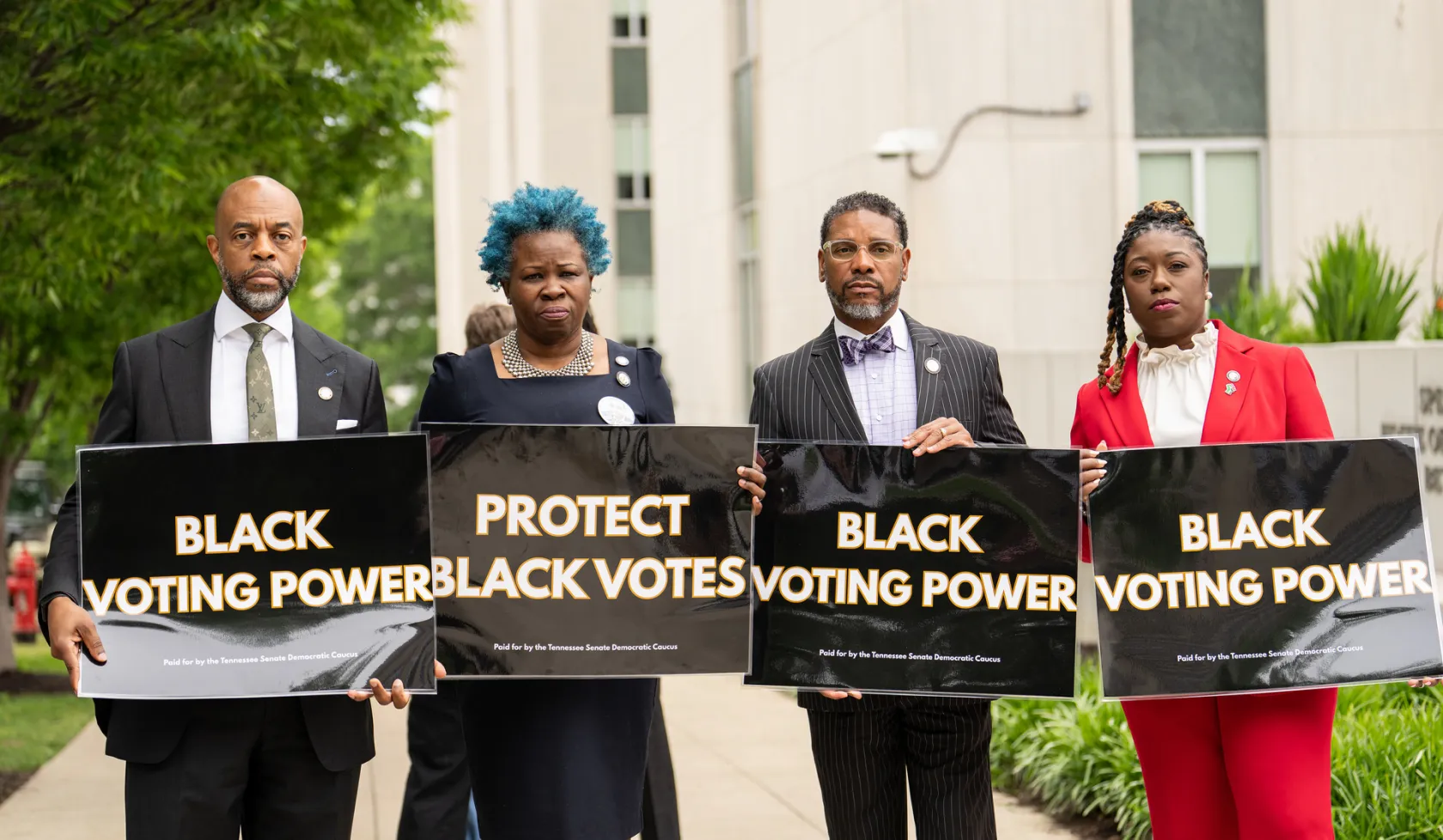
NASHVILLE, Tenn. — The NAACP and the NAACP Tennessee State Conference and impacted voters, along with co-counsels the Lawyers’ Committee for Civil Rights Under Law and LDF, have filed a motion for a preliminary injunction to block Tennessee’s newly enacted congressional map, which dismantles the state’s only majority-Black district and unlawfully dilutes Black voting power. The filing is available here. 
 

The motion asks the U.S. District Court for the Middle District of Tennessee to halt implementation of the map before the 2026 elections, arguing that the plan was enacted with discriminatory intent in violation of the Fourteenth and Fifteenth Amendments. 
 

“Let’s be clear: this map is not about fairness, it’s about fear,” said Derrick Johnson, President and CEO of the NAACP. “Tennessee lawmakers saw Black political power and made a calculated decision to dismantle it. They rigged the system and diluted our community’s voting power. We will not allow officials to cheat and silence our voices. We’ll fight this injustice in every courtroom necessary.” 
 

Last month, Tennessee lawmakers rushed through legislation that eliminated Congressional District 9, a Memphis-based district that has served as the state’s only majority-Black district for decades. Within days of the Supreme Court’s decision in Louisiana v. Callais, the legislature carried out a special session that led to the dismantling of Congressional District 9 by cracking the Black population across three districts.
  

“We’re fighting for our communities, our neighborhoods, and our voices,” said Gloria Sweet-Love, President of the Tennessee State Conference of the NAACP. “In Memphis and across Shelby County, we’ve built generations of advocacy, organizing, and civic power. This intentionally discriminatory map seeks to break that apart by dividing us and weakening our voice at the ballot box. We’re calling on the courts to stop this map before elections, before it can harm our communities.”  
 

The filing details how lawmakers ignored clear warnings that the plan would harm Black voters, used questionable and inconsistent explanations for their actions, and departed sharply from traditional redistricting standards in a rushed and opaque process.  
 

“Make no mistake, what we are seeing in Tennessee and across the South is an undeniable effort to strip Black voters of their power and their voice,” said Kristen Clarke, General Counsel of the NAACP. “The evidence here shows a calculated and intentional effort to dismantle a longstanding majority-Black district through a rushed, opaque process. A preliminary injunction ahead of elections is necessary to ensure that elections proceed under a lawful and constitutional map.” 
 

“Tennessee’s congressional map continues a troubling pattern of stifling Black political power and fracturing communities that have long organized to make their voices heard,” said Shaylyn Cochran, deputy executive director at the Lawyers’ Committee for Civil Rights Under Law. “Our complaint underscores the serious and ongoing harm voters face under this map, and we will continue to fight until Black voters in Tennessee are both able and empowered to make their voices heard. This is not a ‘nice to have.’ It is the cornerstone of our democracy.” 
 

The motion demonstrates that Black voting power in Memphis and Shelby County has been fractured, making it more difficult to elect candidates of their choice. It further shows that race played a central role in the map’s configuration, despite lawmakers’ claims to the contrary. 
 

“Targeting Black voters by intentionally severing their communities into three districts to entrench white political power is both shameful and illegal,” said Kathryn Sadasivan, Counsel at the Legal Defense Fund. “Black voters deserve fair representation in government, and they have suffered decades of intentional and blatant discrimination at the hands of those who oppose a free and fair multiracial democracy. Tennessee legislators turned their backs on Black voters and abandoned their core responsibility to protect their constituents when enacting this map. The court must not follow in their footsteps.” 
 

The NAACP’s motion underscores that without immediate court intervention, Black voters will suffer irreparable harm, including the loss of fair representation in upcoming elections — harm that cannot be undone after ballots are cast. The motion is filed on behalf of civil rights and social justice organizations including the National Urban League.  
 

“Memphis has paid too high a price for the right to vote to have its power carved up behind closed doors,” said Marc H. Morial, President and CEO, National Urban League. “The Memphis Urban League’s complaint speaks directly to the question of whether our democracy will honor equal protection and the Voting Rights Act, or tolerate modern-day vote dilution. We stand with the Memphis Urban League and the people of Memphis in demanding maps that reflect communities, not discrimination.” 
 

This latest action in Tennessee is part of NAACP’s broader effort to challenge discriminatory redistricting practices nationwide and to defend the fundamental right to vote. For more information, visit www.naacp.org. The filing is available here. 
 

# # #  

Victory: Virginia Halts Unlawful Rejection of College Student Voter Registration Applications

MEDIA CONTACTS: 
NAACP: communications@naacpnet.org | Advancement Project: mediadesk@advancementproject.org 

WASHINGTON –  Today, in a significant victory for Virginia college students, a federal district court judge approved a consent decree requiring Virginia officials to accept certain voter registration applications completed by college students. Previously, students’ voter registration applications were being rejected due to immaterial mistakes or omissions. The consent decree can be found here

The consent decree, adopted by the Virginia State Board of Elections to resolve a lawsuit brought by the NAACP, prohibits officials from rejecting registration applications submitted by eligible students that omit unnecessary details like a dorm room number or campus mailbox number.  Officials across Virginia have been rejecting large numbers of student applications for this reason in recent years, including during the leadup to the November 2025 statewide election. 

“This consent decree is a major win for Virginia voters,” said John Powers, Legal Director at Advancement Project.  “For too long, too many Virginia college students have been disenfranchised due to unnecessary and burdensome restrictions.  This agreement removes those barriers and mandates important reforms that will allow more students to register successfully and cast ballots that count.” 

The consent decree mandates the following: 

(1) Virginia students who live on campus will not have their registration applications rejected for providing an address that does not include a dorm name, dorm room number, campus mailing address, or campus mailbox number, when that information is not needed to place students in a precinct.  

(2) Virginia officials must provide guidance and training to local registrars on this requirement and on how to handle student voter registration applications.   

(3) Officials must amend Virginia’s voter registration application to make clear what address information is needed for people living in student dormitories and other group housing.  

(4) Virginia officials must engage in rulemaking efforts to codify the new registration requirements in the Virginia Administrative Code. 

The consent decree is part of a settlement agreement resolving a lawsuit initially brought by the NAACP Virginia State Conference last year against Virginia election officials.  NAACP Virginia and Advancement Project filed the case shortly before the November 2025 general election. Their investigation found that college students across Virginia, including those at HBCUs such as Norfolk State University and Virginia State University, were being kept off the voter rolls because their registration applications did not include certain campus address-related details — even though providing that information is not required under Virginia law. 

“This agreement makes clear that eligible voters cannot be denied access to the ballot based on technicalities that have nothing to do with their eligibility,” said Anthony P. Ashton, Senior Associate General Counsel at NAACP. “College students in Virginia — particularly those at historically Black colleges and universities — have faced unnecessary and unlawful barriers to voter registration. This consent decree sends a strong message that those practices will not stand. The NAACP will continue to fight to ensure that every eligible voter, regardless of age or address, has a fair and equal opportunity to participate in our democracy.” 

The NAACP Virginia State Conference has long worked to eliminate barriers to the ballot box and ensure equitable access to voting for all Virginians. Its victory in this case vindicates the organization’s commitment to protecting the rights of young voters and preventing systemic disenfranchisement.  

For interviews, contact mediadesk@advancementproject.org or communications@naacpnet.org.  

NAACP Condemns Supreme Court Ruling Allowing Discriminatory Alabama Congressional Map

une 3, 2026
Contact: Communications@naacpnet.org

WASHINGTON — The NAACP is condemning the U.S. Supreme Court’s latest decision allowing Alabama to use a congressional map previously found to be intentionally discriminatory against Black voters, warning that the ruling marks another dangerous step in the dismantling of voting rights in the state and across the country. 

The Court’s action follows its most recent decision in Louisiana v. Callais, which has triggered racial gerrymandering efforts across the South. 

“This Court is actively working to strip Black voters of power and voice at a speed that has pulled us right back into the Jim Crow era. Our message to communities remains the same — the best way to express dissent is by showing up at the ballot box this election season,” said Kristen Clarke, General Counsel of the NAACP. “The Supreme Court continues to unleash chaos in our democratic process, and with this latest action, gives Alabama approval to use a congressional map that had previously been found to be infected with racially discriminatory intent.”

The NAACP emphasized that fair and representative districting is essential to ensuring that Black communities have an equal opportunity to elect candidates of their choice and participate fully in the political process. Decisions like this one not only weaken representation in Congress but also threaten access to critical resources and policy outcomes that impact communities nationwide.

As states – particularly southern states – continue to pursue redistricting efforts that diminish Black voting strength, the NAACP reaffirmed its commitment to pursuing all legal, legislative, and grassroots strategies available to protect voting rights and hold decision-makers accountable.

The NAACP urges voters to remain engaged and mobilized this election season, emphasizing that civic participation and voting remain the most powerful tools in the fight to safeguard democracy. As such, the Association is currently leading mobilization campaigns across the country this midterm season to continue driving voters to the polls to elect leaders who will advocate on their behalf. 

For more information, visit naacp.org

Out of Bounds

We’re calling for Black athletes, families, alumni, and fans to withhold athletic and financial support from public universities in southern states attacking Black voting rights.

No Representation. No Recruitment.
No Revenue.

Across the South, Black athletes have helped build some of the most profitable college athletic programs in America, generating hundreds of millions of dollars in annual revenue. At the same time, several southern state governments are moving to limit, reduce, weaken, or erase Black voting representation by creating new, unconstitutional voting districts. 

You can’t have one without the other. Profiting off of Black athletes while suppressing their vote is out of bounds.

NAACP Calls on Black Athletes & Fans to Withhold Support of Public Schools in States Attacking Black Voting Rights

Contact: Chyna Fields, cfields@naacpnet.org

WASHINGTON — The NAACP today launched the “Out of Bounds” campaign, a national call for Black athletes, families, fans, alumni, and consumers to withhold athletic and financial support from public universities in states that have moved to limit, weaken, or erase Black voting representation in the wake of the Supreme Court’s 6-3 ruling in Louisiana v. Callais, which gutted what was left of the Voting Rights Act. The NAACP identified eight priority states — Tennessee, Louisiana, Alabama, Florida, Mississippi, South Carolina, Texas, and Georgia — and targeted flagship public athletic programs generating more than $100 million in annual revenue that continue to recruit Black athletes while their state governments dismantle the political power of Black communities.

“What these states have done is not a policy disagreement. It is a sprint to erase Black political power,” said Derrick Johnson, President & CEO, NAACP. “These actions happened in days, in some cases in hours, of a Supreme Court ruling that gives extremist lawmakers a playbook to erode Black representation. The NAACP will not watch the same institutions that depend on Black athletic prowess to fill their stadiums and their bank accounts remain silent while their states strip Black communities of their voice. Out of Bounds is our answer: we are naming the contradiction, and we are calling on Black athletes, families, fans, and consumers to act on it. The same power that built these programs can be redirected. And it will be.”

The economic stakes of the campaign are significant. The flagship universities in the eight targeted states collectively generate billions of dollars in annual athletic revenue.

The “Out of Bounds” campaign focuses on one primary ask, calling on top football and basketball recruits currently being actively recruited by targeted programs to withhold their commitments until the states in question restore fair congressional maps and meaningful Black representation. The campaign also calls on current college athletes — including those who may already be enrolled at targeted programs — to consider their options, including the transfer portal, and to use their platforms and NIL reach to elevate fair maps and voting rights.

“This generation of Black athletes understands something that those who came before them were never afforded the chance to say so plainly: your talent is yours, and so is your community’s political power,” said Tylik McMillan, National Director, Youth and College Division, NAACP. “These are not separate issues. The state that is working to erase your grandmother’s congressional district is the same state whose governor will stand on the field and celebrate your touchdown or game-winning shot. We are asking young people — recruits, current athletes, fans — to see that connection clearly and to act on it. The Out of Bounds campaign is about redirecting what has always been ours, power and perseverance.”

The campaign issues calls to action across three audiences. 

  • Black athletes and recruits are asked to withhold commitments from targeted programs, to ask coaches and athletic directors where their universities stand on voting rights, and to visit and seriously consider HBCUs.
  • Current college athletes are asked to use their platforms to elevate the issue, to ask institutional leadership for public statements opposing racial vote dilution, and to consider all available options under the transfer portal.
  • Fans, alumni, donors, and consumers are asked to stop purchasing tickets, merchandise, and licensed apparel from targeted programs and to redirect that spending to HBCUs — their athletics programs, scholarship funds, NIL collectives, bands, and alumni foundations.

The Out of Bounds campaign will remain in effect until targeted states adopt state-level voting rights protections, repeal maps that dilute Black voting power, restore congressional and judicial districts that reflect the Black population’s actual strength, and commit to transparent and community-centered redistricting processes. Our sentiment is clear: No Representation. No Recruitment. No Revenue.

NAACP, Civil Rights Groups Urge Court to Stop Trump Order Blocking Mail-in Ballots

May 14, 2026

Contact: Chyna Fields, cfields@naacpnet.org 

WASHINGTON– In the first hearing of NAACP v. Trump today, the NAACP, Common Cause, Black Voters Matter, and the Lawyers’ Committee for Civil Rights Under the Law urged the court to immediately stop President Trump’s latest executive order on mail-in ballots, which would give the federal government control over how Americans vote. The executive order was released in March 2026, and the NAACP opposed it.  

Today, plaintiffs argued the executive order illegally overrides state and congressional authority to set election law. By conditioning mail-in voting to the use of an unreliable, notoriously error-ridden federal database, the order also threatens to prevent millions of eligible voters from casting ballots. Additionally, the administration’s threats of prosecution would also irreparably harm both individual voters and interfere with the success of civic engagement efforts made by organizations like the NAACP.   

“Whether by mailbox or ballot box, every American deserves the right to cast their vote,” said Derrick Johnson, NAACP President and CEO. “Mail-in ballots have long helped provide access to the democratic process for Black voters, Americans in rural communities, the military and overseas citizens, the elderly, people who can’t take off work to vote, and more. We should be focusing on ensuring that every American’s voice is heard, not limiting access to the ballot box.” 

Trump’s order creates a sweeping and confusing new system designed to give the federal executive branch veto power over who can vote. Specifically, the order: 

  • Directs DHS to compile a list of purportedly eligible voters in each state, drawn from the SAVE immigration database and Social Security records — databases that are incomplete, outdated, and not designed to verify citizenship or state residence.   
  • Orders the U.S. Postal Service, an independent agency, to refuse delivery of mail-in and absentee ballots for any voter not enrolled on a federally created “Mail-In and Absentee Participation List” — without any requirement to notify the voter or the state that their ballot was blocked.  
  • Threatens criminal prosecution of state and local election officials, individuals, and organizations like the NAACP, Common Cause, and Black Voters Matter, that help voters cast mail-in ballots if the federal government views those voters as ineligible — an attempt to chill voter assistance work.  
  • Threatens to withhold federal funding from any state that does not comply with the order’s demands. 

Last week, the NAACP filed a preliminary injunction motion to block the executive order from taking effect while the lawsuit proceeds. This move aims to prevent further interference and ensure the integrity of our nation’s elections remains in place. We will continue our fight for fair practices in America’s democratic process so every eligible voter may effectively exercise their right to vote.

To view the lawsuit, click here.

To view the preliminary injunction, click here.

May 13, 2026
7:00pm – 8:15pm ET

Zoom

The Wellness Blueprint: A Practical Guide to Supporting Youth Mental Health

Ready to discuss Youth Mental Health?

Join the NAACP Center for Health Equity and the NAACP Youth & College Division for a critical discussion on youth mental healthThe Wellness Blueprint is an engaging webinar designed for youth, educators, parents, community leaders, and advocates who serve on the front lines of support.

Join the Conversation

With young people experiencing unprecedented levels of stress, anxiety, and emotional strain, this moment demands more than awareness — it calls for action

This session provides a practical roadmap for shifting from crisis response to holistic prevention. Participants will gain accessible tools and strategies to strengthen youth mental well‑being across schools, homes, and communities. 

Register Here

NAACP Condemns Supreme Court’s Ruling Against Voting Rights

Contact: Chyna Fields, cfields@naacpnet.org

WASHINGTON — In reaction to the Supreme Court’s ruling in Louisiana vs. CallaisNAACP President and CEO Derrick Johnson released the following statement:

“Today’s decision is a devastating blow to what remains of the Voting Rights Act, and a license for corrupt politicians who want to rig the system by silencing entire communities. The Supreme Court betrayed Black voters, they betrayed America, and they betrayed our democracy. This ruling is a major setback for our nation and threatens to erode the hard-won victories we’ve fought, bled, and died for. But the people still can fight back. Our best defense and offense is the ballot box, and we’re going to turn out voters for the midterm elections to make sure we can elect representatives who look out for us. Our democracy is crying for help.”

Kristen Clarke, NAACP General Counsel added: 

“This is one of the most-consequential and devastating rulings issued by the Supreme Court in the 21st Century. The Supreme Court has put the death knell into our nation’s most important federal civil rights law, one that provided Black Americans access to a democracy that they had long been excluded from. The ruling defies precedent, ignores statutory text, and will reverse decades of progress we have made as a nation. This will embolden lawmakers in former slave-holding states to target and eradicate districts that have provided Black Americans a fair opportunity to elect candidates of choice, and they will do so with the blessing of this Court. It ignores the tremendous sacrifice made by Americans who bled and died for passage of the Voting Rights Act.

“Expect more Americans to call into question the integrity and independence of this Court which is moving unabashedly and at lightning speed to dismantle our bedrock civil rights protections.

“The NAACP will not stand by idly in the face of this ruling which seeks to diminish our standing and render us second-class citizens. This is not a moment for any one of us to sit on the sidelines. We are witnessing the full machinery of government aided by the Court disenfranchising and silencing Black America and hijacking democracy as we know it. We will continue to fight and ensure that our voices are heard this midterm election cycle.”

NAACP Applauds Reps. Ramirez & Mejia for Introducing Living Wage for All Act

FOR IMMEDIATE RELEASE  

April 28, 2026 
CONTACT: Communications@naacpnet.org

WASHINGTON — NAACP, One Fair Wage, labor and economic justice leaders from across the country came together at the U.S. Capitol to stand with Rep. Delia Ramirez (IL-03) while she introduced the Living Wage for All Act, a landmark federal bill co-sponsored by Rep. Analilia Mejia (NJ-11) that would raise the federal minimum wage to $25 per hour — the floor that working families need to meet the real cost of living in America today. 

The bill introduction featured Members of Congress, NAACP, national leaders from the Living Wage For All Coalition, and directly impacted workers from across sectors sharing why the affordability crisis is not just a cost-of-living crisis, but is a wage crisis, urging Congress to raise the minimum wage to a living wage to meet the true cost of living.    

“For 17 years, Washington has left the federal minimum wage at $7.25 while working people have fallen further behind,” said Derrick Johnson, President & CEO, NAACP. “Our communities don’t need lip service or slogans — they’re demanding real solutions that match the reality of this economy. A living wage is about dignity, but it is also about who holds power in this country. It’s tied to every other fight for civil rights — from racial justice, to voting rights, to economic opportunity. When people are denied fair wages, they are denied the ability to fully participate in our democracy. The NAACP stands with this coalition and applauds the introduction of the Living Wage for All Act because civil rights, racial justice, and economic justice are inseparable.” 

“This is a worker-led movement that has grown from the groundbreaking Fight for $15 into a nationwide push for a true living wage. Across the country — from California to the Midwest to the East Coast — workers are organizing for $25 and $30 because that is what it takes to live. The polling shows this is not just popular, it is necessary. And ‘for all’ means exactly that: no worker left behind. This is what it looks like when politics begins to catch up to reality — and when democracy delivers real improvements in people’s lives, it becomes tangible. A living wage is how we make that promise real.” — Saru Jayaraman, President, One Fair Wage

The legislation sits at the center of a rapidly expanding national push to match wages with the real cost of living. The federal minimum wage has remained stuck at $7.25 since 2009. For more than 17 years, workers have absorbed rising costs for rent, groceries, childcare, and healthcare while their wages have remained stagnant. The Living Wage for All Act establishes a new national wage floor grounded in economic reality, not political compromise. 

Watch the full press conference here
 
Background: The Living Wage for All Act would raise the federal minimum wage to $25 per hour through a phased approach that reflects both the cost of living and the structure of the modern economy. 

The bill establishes a two-track phase-in, requiring large, highly profitable corporations to lead the transition. Large employers would reach $25 by 2031, while smaller employers would phase in more gradually, reaching $25 by 2038. 

To ensure wages do not fall behind again, the bill includes a built-in standard that keeps the minimum wage aligned with typical wages across the economy. As the economy grows and wages rise, the minimum wage would rise with it. 

The legislation also eliminates all subminimum wages, including tipped workers, youth workers, and workers with disabilities — ensuring that every worker is guaranteed a full wage from their employer, with no exceptions. 

### 

Living Wage For All Coalition 

The Living Wage for All Coalition is a national campaign of more than 100 labor, community, civil rights, and economic justice organizations working together to win a living wage for every worker in America. The coalition is advancing a multi-level strategy through federal legislation, state ballot measures, and local campaigns to raise wages, end all subminimum wages, and ensure that work pays enough to meet the real cost of living — with no exceptions. 

NAACP 

The NAACP advocates, agitates, and litigates for the civil rights due to Black America. Our legacy is built on the foundation of grassroots activism by the biggest civil rights pioneers of the 20th century and is sustained by 21st century activists. From classrooms and courtrooms to city halls and Congress, our network of members across the country works to secure the social and political power that will end race-based discrimination. That work is rooted in racial equity, civic engagement, and supportive policies and institutions for all marginalized people. We are committed to a world without racism where Black people enjoy equitable opportunities in thriving communities. 

One Fair Wage 

One Fair Wage is a national organization of nearly 300,000 service workers, over 1000 restaurant employers, and dozens of organizations nationwide all working together to raise wages for all workers, end all subminimum wages in the United States, and improve working conditions in the service sector in particular. One Fair Wage policy would require all employers to pay the full minimum wage with fair, non-discriminatory tips on top, thus lifting millions of tipped and subminimum wage workers nationally out of poverty. For more information, visit www.onefairwage.org

National Education Association 

The National Education Association is the largest labor union in the United States, representing more than 3 million educators, school staff, and education professionals across the country. NEA advocates for public education, economic justice, and the success of every student, working to ensure that schools are well-funded, educators are respected, and communities are supported. 

Center for Popular Democracy 

The Center for Popular Democracy is a national network of community-based organizations that builds power to advance racial and economic justice. CPD partners with grassroots groups across the country to win progressive policy change through organizing, advocacy, and electoral campaigns, with a focus on expanding democracy, raising wages, and creating an economy that works for all. 

Policy Link  

PolicyLink is a national research and action institute advancing racial and economic equity by Lifting Up What Works®. Through research, advocacy, and partnerships with communities, PolicyLink works to ensure that all people — especially those in low-income communities and communities of color — can participate in and benefit from a just and fair economy. PolicyLink develops data-driven solutions and policy strategies that address income inequality, expand opportunity, and build an inclusive economy nationwide.